
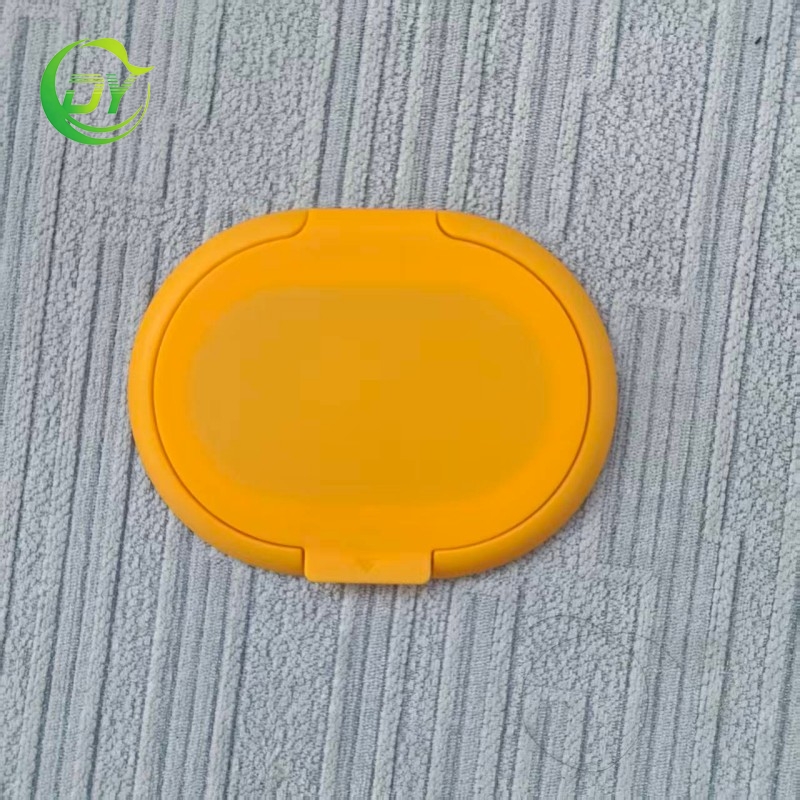
Plastic Wet Wipes Lid Wholesale buyers need the right adhesive to bond a PP wet wipes lid to flexible packaging without leaks, lifting edges, or poor resealing. PP has a low surface energy, often about 29 to 31 mN/m, so many adhesives do not wet or grip it well. The same issue can affect a resealable wipes package during storage, transport, and daily use.
Flexible packaging film may include PET, PE, PP, aluminum foil, or a multilayer laminate. Each material has a different surface and seal behavior. A pressure sensitive adhesive must bond to both the lid and the film while keeping a stable peel force.
For Dongyang purchasing teams, adhesive selection should include bond strength, opening force, moisture resistance, and production speed. A low-cost adhesive can create higher waste if the lid fails after filling or during customer use.
Common terms in this field include low surface energy plastic, resealable wipes packaging, and peel strength testing. These terms describe the main technical challenges when bonding PP lids to flexible film.
Reliable results require more than adhesive selection. Surface treatment, adhesive coating weight, curing time, die-cut accuracy, and quality inspection must also be controlled.
The best adhesive for bonding a PP wet wipes lid to flexible packaging is usually a high-tack acrylic or rubber-based pressure sensitive adhesive that is approved for the package structure and tested on the actual film. For difficult PP surfaces, use corona or plasma treatment, or select a primer-assisted adhesive system. A practical starting target is a 5 to 15 N per 25 mm peel force after 24 hours, with no edge lifting after moisture and temperature testing. The final choice must be confirmed through production trials, ASTM peel testing, leakage tests, and storage simulation.
Polypropylene is light, tough, and resistant to water. It is widely used for plastic wet wipes lids because it supports repeated opening and closing. However, its low surface energy makes adhesive wetting difficult.
A typical PP lid may have a thickness of 0.8 to 2.0 mm. The lid should remain flat after molding. Warpage above about 0.5 mm across the bonding area can reduce contact and create air channels.
Wet wipes packs often use a laminated structure such as PET/PE or PET/CPP. The outer layer provides printability and stiffness. The inner layer provides heat sealing and contact with the wipes.
| Packaging surface | Typical feature | Adhesive concern |
|---|---|---|
| PP | Low surface energy, water resistant | Poor wetting and low initial grip |
| PE | Flexible and low surface energy | Edge lifting and adhesive transfer |
| PET | High stiffness and good print surface | Adhesive must handle film tension |
| CPP | Heat sealable polypropylene film | May need surface treatment for strong bonding |
| Aluminum laminate | High barrier against oxygen and moisture | Adhesive must bond to the treated film layer |
Wet wipes contain water, preservatives, fragrances, and sometimes alcohol or lotion ingredients. These substances may reach the lid edge during use. The adhesive must resist moisture without becoming soft or losing tack.
For a new design, test the complete pack instead of testing only a dry film coupon. A complete pack gives more useful results because the lid, adhesive, laminate, wipe liquid, and package shape affect the bond together.
| Adhesive type | Main advantages | Limitations | Best use |
|---|---|---|---|
| Acrylic pressure sensitive adhesive | Good aging resistance, clean appearance, stable peel | May need primer or surface treatment on PP | Premium resealable wipes packaging |
| Rubber pressure sensitive adhesive | High initial tack and good contact with rough surfaces | May show lower heat and aging resistance | Fast production and low to medium temperature storage |
| Hot melt adhesive | Fast setting, no solvent drying, high production speed | Heat sensitivity and possible adhesive ooze | High-speed automated lid application |
| Solvent-based adhesive | Strong bond and wide substrate range | Requires solvent control, drying, and ventilation | Specialty laminates and demanding structures |
| Water-based adhesive | Lower solvent emissions and easy handling | Drying time and moisture resistance can be limiting | Controlled film structures with suitable drying equipment |
Acrylic pressure sensitive adhesive is a strong option when the package needs stable performance over several months. It is often selected for a resealable wet wipes lid with a clean opening action and low odor.
Use an acrylic system when the product may face temperatures from 5 C to 40 C during normal storage. Confirm the result with accelerated aging at 40 C to 60 C, depending on the planned shelf life and customer requirements.
Rubber-based adhesive can provide high initial tack. This helps when the flexible film has a slightly uneven surface or when the production line needs quick handling after lid application.
However, rubber systems may soften under high heat. They may also lose performance faster under ultraviolet light and long-term aging. Use a protective liner and verify adhesive transfer after repeated opening cycles.
Hot melt adhesive can support high-speed production because it solidifies as it cools. A typical application temperature may range from 120 C to 180 C, depending on the formulation and equipment.
Hot melt systems need close control of temperature, coating weight, and open time. Excess heat may distort a thin flexible film or deform a PP lid. The adhesive should also be checked for stringing, edge ooze, and blocking during roll or stack storage.
Corona treatment increases the surface energy of PP and can improve adhesive wetting. A common production target is at least 38 to 42 mN/m, but the required value depends on the adhesive and film structure.
Surface energy should be checked with dyne test pens or calibrated test fluids. Test the actual production roll because surface treatment can decrease during storage. A practical control plan checks the treated film at the start of each shift and after long production stops.
Plasma treatment can provide more controlled activation on selected PP parts. It may be useful when the lid has a narrow bonding flange or a complex shape.
A primer can improve adhesion when surface treatment alone is not enough. The primer must be compatible with the pressure sensitive adhesive and the final package. It should also meet the intended food contact or consumer product requirements when applicable.
Dust, mold release residue, oil, and fingerprints can reduce peel strength. The bonding surface should be dry and free from visible contamination.
Keep treated PP away from dust and excessive handling. Apply the adhesive within the supplier's recommended treatment window. Many treated polyolefin surfaces lose performance as the activated layer changes over time.
| Performance item | Suggested starting target | Recommended test or control |
|---|---|---|
| Peel strength | 5 to 15 N per 25 mm after 24 hours | ASTM F88 or a controlled 180 degree peel method |
| Initial tack | Continuous contact without visible lifting | Loop tack or quick peel screening |
| Adhesive coating weight | 30 to 60 g per square meter, based on design | Gravimetric or area-based coating check |
| Opening force | About 2 to 8 N for many consumer formats | Force gauge at a fixed peel speed |
| Leak performance | No leakage after pressure and inversion checks | ASTM D3078 or an approved internal method |
| Edge lift | No visible lift after aging | Temperature and humidity exposure |
| Repeated opening | At least 20 to 50 cycles for design screening | Manual or machine cycling with recorded force |
These values are starting points, not universal requirements. A baby wipes pack, cosmetic wipes pack, and industrial cleaning wipes pack may need different targets. The opening force must be high enough to protect the seal but low enough for ordinary users to open the lid.
Inspect the failure mode, not only the force value. Adhesive failure occurs when the adhesive releases from the surface. Cohesive failure occurs when the adhesive splits inside its own layer. Film tear or fiber tear usually indicates a stronger bond than the packaging layer.
For a controlled resealable package, clean adhesive failure is often preferred in the opening zone. Permanent adhesive bonding may be preferred under the hinge or fixed flange. This design can reduce the risk of the lid separating from the pack.
Useful equipment includes a peel force tester, digital force gauge, dyne test pens, coating weight balance, thickness gauge, temperature and humidity chamber, leak tester, and visual inspection lighting.
A peel tester should use a fixed peel angle and speed. Common test speeds include 300 mm per minute, but the same speed must be used for every comparison. Record the sample width, aging time, temperature, and failure mode with the force result.
The lid flange should have enough width to create a stable bond. A bonding width of 3 to 8 mm is common for small and medium wet wipes packs, but the final value depends on the lid design and package size.
Use a rubber roller or compression plate to apply even pressure. Gaps, wrinkles, and trapped air reduce the real contact area. A visual inspection system can check lid position, flange contact, contamination, and edge lifting at line speed.
Store finished samples at 23 C and 50 percent relative humidity for baseline testing. For accelerated screening, use 40 C and 75 percent relative humidity for 7 to 14 days when the package and wipe formula can tolerate these conditions.
After conditioning, measure peel strength and opening force again. A change of more than 20 to 30 percent from the initial result should be reviewed. The package should also be checked for liquid leakage, lid distortion, and adhesive migration.
Use an internal pressure test or a standard method such as ASTM D3078 when the package structure is suitable. Test filled packs, not only empty samples.
Inspect packs after inversion, compression, and transport simulation. A simple screening plan can include 10 packs per condition. For a formal validation plan, use a larger sample size based on the customer's quality agreement.
Many wet wipes lids are opened more than once. Test at least 20 cycles during early development. Premium products may require 50 cycles or more.
Record the opening force at the first, tenth, twentieth, and final cycle. Also check whether the adhesive transfers to the lid, whether the film tears, and whether the lid still covers the opening completely.
The cheapest adhesive may have a low initial cost but create higher rejection rates. A 1 percent increase in package rejects can be costly in a high-volume wet wipes line. Compare total cost, including adhesive, production speed, inspection, rework, and customer returns.
Dry film testing does not show how wipe liquid affects the bond. Use the actual lotion, preservative system, and filled package during validation.
A package can pass a 24-hour test and fail after several weeks. Include real-time aging when possible. Use accelerated aging to identify risk before full shelf-life data is available.
Acrylic adhesive that bonds well to PET may not bond well to PE or treated PP. Request data for the exact film structure. Do not assume that two films with the same outer appearance have the same adhesive surface.
A higher coating weight does not always create a stronger or cleaner package. Excess adhesive can cause squeeze-out, edge contamination, blocking, and difficult opening. Screen at least three coating weights during development.
| Inspection stage | Control item | Example frequency |
|---|---|---|
| Incoming adhesive | Batch number, viscosity, appearance, shelf life | Each batch |
| PP lid inspection | Dimensions, flange flatness, flash, color, warpage | First article and sampled batches |
| Film inspection | Thickness, surface energy, wrinkles, print defects | Each roll and production change |
| Bonding line | Application pressure, temperature, alignment, coating weight | Start-up and scheduled checks |
| Finished package | Peel force, opening action, leaks, lid position | Each production lot |
A practical development program can compare three adhesive types, three coating weights, and two surface treatments. This creates 18 initial combinations. Test at least 10 samples per combination for peel force and visual failure mode. The best two combinations can then move to temperature, moisture, and repeated-cycle testing.
For Dongyang project teams and Plastic Wet Wipes Lid Wholesale customers, this method creates a clear decision record. It also makes it easier to repeat the result when the film supplier, lid mold, or adhesive batch changes.
Adhesive selection for bonding PP wet wipes lids to flexible packaging depends on the PP surface, film laminate, wipe liquid, opening design, and production process. High-tack acrylic and rubber pressure sensitive adhesives are common starting choices. Hot melt adhesive can support fast lines when temperature and coating controls are stable.
The most reliable approach is to treat the low surface energy PP when needed, control the bonding process, and test the filled package under real use conditions. Measure peel strength, opening force, leakage, edge lift, and repeated opening performance. With clear targets and documented inspection, Plastic Wet Wipes Lid Wholesale buyers can reduce package failures and produce a more reliable resealable wet wipes package.