
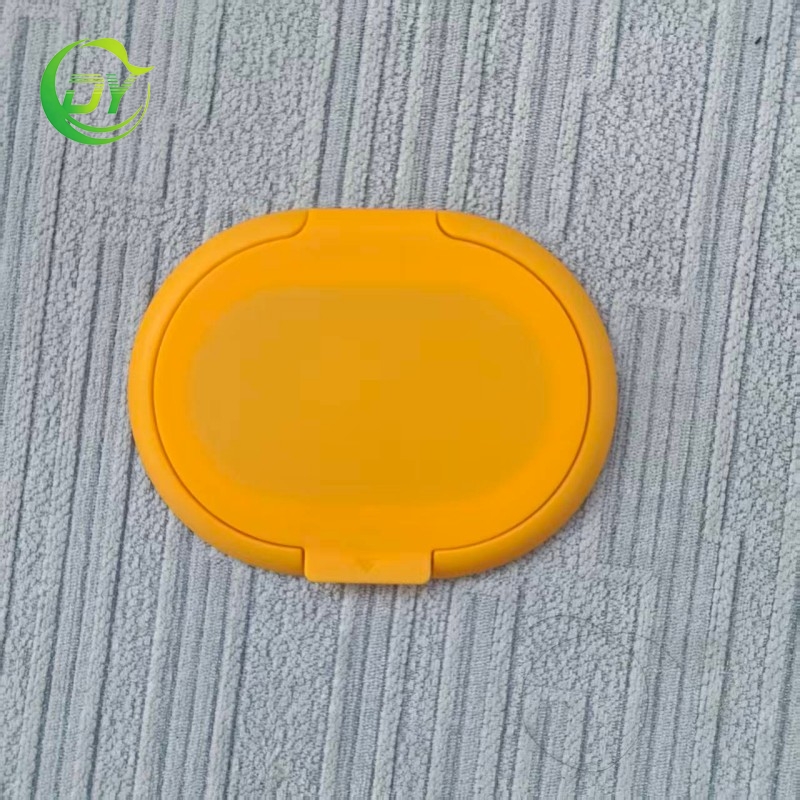
Plastic Wet Wipes Lid Wholesale buyers need lids that protect moisture, open smoothly, and stay attached to the pack during transport. A poor polypropylene lid may warp, leak, or break after repeated use. The lid must also match the pack opening, film, adhesive, and filling process.
Many buyers compare only the unit price of a flip top wet wipes lid. However, mold design and material control have a direct effect on product life.
A reliable living hinge should support thousands of opening and closing cycles without cracking. The lid also needs a stable snap fit and a flat sealing surface.
For this reason, buyers should review injection molding requirements before placing a bulk order. The correct process can reduce leakage, poor fit, short shots, and high rejection rates.
This guide explains the key requirements for wet wipes lid injection molding, including material selection, mold construction, production control, and inspection.
High-quality wet wipes lids require a suitable polypropylene grade, accurate mold design, controlled injection temperature and pressure, stable cooling, and complete quality inspection. A practical specification often includes dimensional tolerance of about plus or minus 0.10 to 0.20 mm for key fitting areas, a smooth sealing surface, a living hinge tested for at least 1,000 open and close cycles, and leak testing under controlled pressure. The final requirements must match the wipes pack, filling line, adhesive, and target market regulations.
Polypropylene, also called PP, is widely used for wet wipes lids because it is light, durable, and suitable for high-speed injection molding. It also supports flexible hinge designs and many surface finishes.
For a standard lid, a PP melt flow rate of about 8 to 25 g/10 min may be suitable. The exact grade depends on the lid size, wall thickness, hinge design, and injection machine. The selected resin should have consistent flow and low contamination.
For products that contact wipes or liquid residue, the material should meet the required food contact, cosmetic packaging, or chemical compatibility rules of the target market. The manufacturer should provide a resin batch record and a material compliance document.
| Requirement | Recommended control | Reason |
|---|---|---|
| Material type | Injection molding grade PP | Provides strength, flow, and hinge flexibility |
| Color consistency | Use a controlled masterbatch ratio and approved color sample | Prevents shade differences between batches |
| Moisture and contamination | Store resin in sealed bags and inspect before use | Reduces black spots, bubbles, and weak areas |
| Material traceability | Record supplier, batch number, and production date | Supports fast investigation when defects occur |
Although PP normally has low moisture absorption, poor storage can still cause dust, mixed materials, and color contamination. Resin should be kept away from water, oil, and open production waste.
Uneven wall thickness is a common cause of warpage and sink marks. A practical wall thickness for many wet wipes lids is about 1.5 to 2.5 mm. Large changes in thickness should be avoided.
Ribs can improve strength, but they should not be too thick. A rib thickness of about 40 to 60 percent of the main wall thickness can reduce sink marks. Rounded corners also help plastic flow and reduce stress.
The living hinge connects the lid to the base. It must bend repeatedly without whitening or cracking. The hinge should have a uniform thin section and a smooth transition into the surrounding plastic.
Many PP living hinges use a thin section of about 0.25 to 0.50 mm. This is only a starting range. The final design must be confirmed through mold trials because resin grade, flow direction, and hinge length affect performance.
A suitable production test is at least 1,000 opening and closing cycles. Premium products may require 3,000 to 10,000 cycles. After the test, the hinge should remain attached and should not show a visible crack.
The snap fit should close with clear feedback but should not require excessive force. A typical opening force target may range from 10 to 30 N, depending on lid size and customer needs.
The sealing area should be flat and free from ejector marks, short shots, and flash. A sealing surface variation of about 0.10 mm or less is often useful for stable pack performance. The final value should be confirmed with the film and adhesive system.
High-volume plastic wet wipes lid wholesale production requires a mold that can run for a long service life. Common mold steels include P20 for general production and hardened steels such as 1.2316 or H13 for areas that need better wear or corrosion resistance.
For a multi-cavity mold, the cavity dimensions should be balanced. A 2-cavity, 4-cavity, 8-cavity, or higher-cavity mold can be selected according to order volume and machine capacity.
Mold alignment should be checked with a coordinate measuring machine. A practical cavity-to-cavity dimensional difference target is often within 0.05 to 0.10 mm for key fitting features.
Gate location affects weld lines, filling pressure, hinge strength, and appearance. The gate should support even filling and keep weld lines away from the snap fit and living hinge where possible.
Hot runner systems can reduce material waste and improve cycle stability. Cold runner systems may be suitable for lower production volumes or simple lid designs. The choice depends on the order size, mold layout, and cost target.
Cooling channels should be placed close enough to the cavity surface to remove heat evenly. Uneven cooling can create warpage, size changes, and poor stacking.
Ejector pins should be placed on strong, non-cosmetic areas. Ejector marks should not appear on the sealing surface or on the main visible face. Mold release should be stable without bending the lid during ejection.
| Process item | Typical starting range | What to monitor |
|---|---|---|
| Barrel temperature | 190 to 230 degrees Celsius for many PP grades | Flow, color, burn marks, and material degradation |
| Mold temperature | 20 to 50 degrees Celsius | Surface quality, shrinkage, and cycle stability |
| Injection speed | Set by filling behavior and hinge design | Short shots, weld lines, flash, and jetting |
| Holding pressure | Set after filling trials | Sink marks, weight, dimensions, and flash |
| Cycle time | Often about 12 to 30 seconds | Part temperature, output, and deformation |
These values are starting points, not fixed rules. The machine operator should use a controlled trial to find the correct settings for the selected resin and mold.
Every production batch should have a process sheet. It should record barrel temperatures, mold temperature, injection speed, holding pressure, cooling time, cycle time, and cavity number.
Process limits should be defined before mass production. For example, a cycle time limit of 18 plus or minus 1 second can help prevent uncontrolled output changes. Actual limits should be based on the approved trial report.
This process is useful for a custom wet wipes lid manufacturer because it connects design approval with production control. It also reduces the risk of producing a full order with an incorrect mold setting.
Key dimensions include the overall length and width, pack opening size, hinge thickness, snap-fit position, lid height, and sealing surface flatness.
Use calibrated vernier calipers, micrometers, height gauges, and coordinate measuring machines. Calibration records should be available. For a high-volume order, the manufacturer may use first article inspection followed by sampling based on ISO 2859-1.
| Inspection item | Suggested method | Example acceptance target |
|---|---|---|
| Critical dimensions | Caliper, micrometer, or CMM | Within the approved drawing tolerance |
| Weight | Electronic scale | Average within plus or minus 3 percent of approved sample |
| Appearance | Visual inspection under standard lighting | No short shot, burn mark, severe flow mark, or sharp flash |
| Snap-fit function | Manual or force gauge test | Closes fully and opens within the approved force range |
| Hinge durability | Repeated open and close test | At least 1,000 cycles unless the specification requires more |
| Leak resistance | Filled pack inversion and pressure test | No visible leakage under the approved test condition |
A leak-proof wet wipes packaging system depends on more than the lid alone. The film, adhesive, base, lid sealing ring, and pack opening must work together.
A practical test can use a filled pack with the intended wipes solution. Close the lid, invert the pack for 24 hours, and inspect for visible leakage. A pressure decay or air pressure test may also be used. The pressure and test time should be written in the product specification.
For transport testing, ASTM D4169 may be used as a reference for distribution simulation. A packaging team may also perform vibration, compression, and drop tests that match the shipping method.
| Defect | Likely cause | Corrective action |
|---|---|---|
| Short shot | Low melt temperature, low injection speed, or poor venting | Adjust filling conditions and improve venting |
| Flash | Excessive pressure, mold wear, or poor mold closing | Reduce pressure and repair the parting surface |
| Warpage | Uneven wall thickness or uneven cooling | Balance the design and improve cooling control |
| Hinge crack | Incorrect hinge thickness, poor flow direction, or weak resin | Improve hinge geometry and validate the PP grade |
| Sink mark | Thick ribs, insufficient holding pressure, or slow cooling | Reduce thick sections and optimize holding conditions |
| Color difference | Incorrect masterbatch ratio or mixed resin batches | Control dosing and verify each material batch |
When selecting a plastic wet wipes lid wholesale supplier, ask for the following documents and data:
Output depends on cavity number and cycle time. For example, a 4-cavity mold running a 20-second cycle can produce about 720 pieces per hour before downtime and quality losses. A 16-hour production day could produce about 11,520 pieces under ideal conditions.
Actual output is lower after mold changes, material loading, inspection, packing, and maintenance. Buyers should request an effective capacity calculation instead of relying only on the theoretical machine speed.
Dongyang suppliers and manufacturers may support different mold structures, packaging formats, and order quantities. Buyers should compare the approved sample, quality records, response time, and total delivery cost, not only the quoted price.
A professional project should include design review, prototype review, mold trial, pilot production, and mass production approval. A useful development plan may include two to four mold trial rounds before final release.
Each trial should record the problem, adjustment, result, and responsible person. This creates a clear link between product design and production performance.
For a new wet wipes lid, validate at least three material batches and three production shifts when possible. This helps confirm that the design performs across normal factory variation.
A sample should not be approved only by appearance. Define measurable targets for fit, closure force, lid flatness, hinge life, leakage, color, weight, and packaging strength.
For example, an approval plan may require:
Injection molding requirements for high-quality wet wipes lids cover material, product design, mold structure, process settings, and inspection. A reliable lid should use a controlled PP grade, balanced wall thickness, a tested living hinge, accurate snap-fit dimensions, and a flat sealing area.
For plastic wet wipes lid wholesale orders, buyers should approve samples with measurable tests. They should also review mold capacity, production records, leak resistance, and batch traceability. A controlled process helps deliver lids that open smoothly, remain attached, protect moisture, and fit the wipes package from the first order to long-term production.