
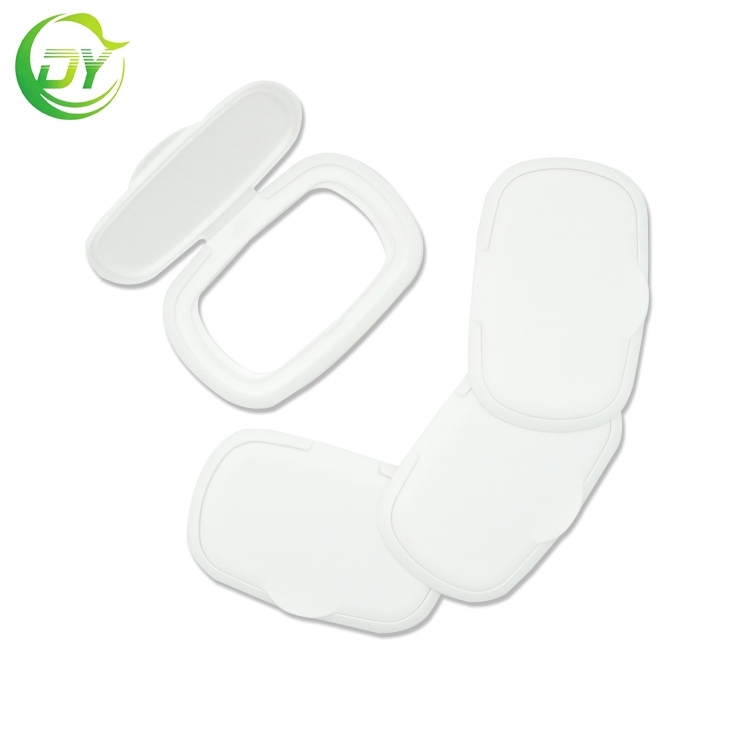
Plastic Wet Wipes Lid Wholesale buyers need a hinge that stays secure after thousands of opening cycles. Parents, cleaners, and industrial users often open a wet wipes pack with one hand, so a weak flip top lid can break or stop sealing.
A reliable wet wipes packaging closure must control hinge stress, lid alignment, and moisture retention. The hinge must also work with different wipe materials, pack sizes, and adhesive seal designs. A good moisture retention seal helps prevent the wipes from drying between uses.
This article explains how to evaluate hinge structure, plastic selection, cycle testing, and quality control before placing a wholesale order.
The best wet wipes lid hinge uses a flexible polypropylene living hinge, controlled hinge thickness, accurate mold alignment, and a positive snap closure. For commercial use, the lid should pass at least 5,000 to 10,000 opening and closing cycles, maintain a stable seal after testing, and show no cracks, sharp edges, or major deformation. Buyers should also confirm material grade, adhesive compatibility, drop performance, and batch inspection records before choosing a plastic wet wipes lid wholesale supplier.
Many wet wipes lids use a polypropylene living hinge. This design is molded as one piece with the lid and base. The hinge zone is thinner than the surrounding plastic, so it can flex without using a separate metal pin.
A practical hinge thickness often falls between 0.25 mm and 0.45 mm, depending on the resin, mold design, and lid size. A hinge that is too thin may crack during assembly. A hinge that is too thick may need excessive opening force and may not flex evenly.
The lid should include a mechanical stop. This feature limits the opening angle and reduces stress on the hinge line. The lid should not be forced backward during normal use.
For a lid with a 70 mm to 100 mm opening length, a hinge width of about 45 mm to 75 mm can provide stable movement. The exact size depends on the container and the required opening area. A rounded transition near the hinge is preferred because sharp corners can create stress concentration.
Polypropylene is widely used because it has low density, good chemical resistance, and suitable fatigue performance. High-density polyethylene can also be used for some designs, but its flexing behavior and mold settings differ.
| Material | Common use | Key benefit | Design note |
|---|---|---|---|
| Polypropylene | Living hinge and flip top lid | Good flex fatigue and chemical resistance | Requires controlled hinge thickness and proper cooling |
| High-density polyethylene | Flexible base parts and selected closures | Good impact resistance | May need a different hinge geometry |
| ABS | Rigid decorative parts | Good surface finish | Usually less suitable for a living hinge |
| TPE overmold | Soft sealing areas | Improves sealing contact and grip | Needs material compatibility testing |
A cycle test measures how the lid performs during repeated consumer use. One cycle means opening the lid to the set angle and closing it until the snap feature is fully engaged.
A basic commercial target is 5,000 cycles. Premium or high-use packaging may require 10,000 cycles or more. The test should use the real lid, base, adhesive seal, and wet wipes. Testing only an empty lid can hide problems caused by pack distortion.
| Test stage | Suggested quantity | Inspection point |
|---|---|---|
| Initial inspection | At least 30 samples per batch | Flash, sink marks, cracks, color, and dimensions |
| Opening force test | 10 or more samples | Consistent user opening force |
| Cycle test | 5,000 to 10,000 cycles | Hinge cracks, lid separation, and lock failure |
| Drop test | 10 drops per sample set | Closure performance after impact |
| Seal test | Before and after cycle testing | Moisture loss and air leakage |
There is no single global standard for every wet wipes lid hinge. Manufacturers often combine internal test methods with recognized plastic and packaging standards.
The final test plan should state the sample quantity, opening angle, cycle speed, temperature, humidity, and acceptance criteria. Without these details, two suppliers may report different results from similar tests.
Step 1: Select samples from the production batch.
Step 2: Record dimensions, weight, color, and initial appearance.
Step 3: Attach the lid to the real wipes pack.
Step 4: Open the lid to 110 degrees.
Step 5: Close the lid until the snap lock engages.
Step 6: Repeat the movement for 5,000 or 10,000 cycles.
Step 7: Measure opening force and inspect the hinge.
Step 8: Test seal retention and moisture condition.
Step 9: Record results and approve or reject the batch.
A closure that requires too much force can make the lid difficult to use. It can also transfer high stress to the hinge. A closure that is too loose may open during transport or fail to protect the wipes from air exposure.
Many projects set an opening force target between 8 N and 20 N. A closing force between 10 N and 25 N may be suitable for common consumer packs. These values are design targets, not universal rules. The final range depends on lid size, user group, pack stiffness, and seal construction.
Important dimensions include hinge width, hinge thickness, lid height, snap position, sealing rim width, and base opening size. A dimensional tolerance of plus or minus 0.10 mm may be suitable for critical snap features. Larger cosmetic surfaces may use a wider tolerance.
Coordinate measuring machines, digital calipers, pin gauges, and go or no-go gauges can support inspection. A supplier should record critical dimensions during mold trials and mass production.
A durable hinge is not enough if the lid does not close evenly. A small gap can allow water and fragrance to evaporate. It can also increase the risk of contamination during storage.
Seal performance can be checked by weighing the complete pack before and after storage. For example, a project may set a 28-day moisture loss limit of 3 percent at 23 degrees Celsius and 50 percent relative humidity. Accelerated testing may use 40 degrees Celsius for 14 days, followed by a comparison with the original weight.
The lid base must allow the adhesive seal to bond correctly. Some surface treatments, printing inks, or mold release residues can reduce adhesion.
Testing should include peel strength, visual seal coverage, and opening performance after the adhesive is removed. The adhesive label should not pull the lid out of alignment or leave residue on the sealing rim.
Injection molding machines for wet wipes lids commonly operate in the range of 80 to 250 tons, depending on cavity count and lid size. A multi-cavity mold can improve output, but it also requires balanced filling and cooling.
Important process records include melt temperature, mold temperature, injection pressure, holding pressure, cooling time, and cycle time. A change in cooling time can affect hinge flexibility and lid warpage.
Dongyang suppliers and production teams can use mold flow review, first article inspection, and process capability tracking to reduce variation. For critical dimensions, a process capability target of Cpk 1.33 or higher is often used when the process is stable and enough data is available.
| Defect | Likely cause | Possible result | Corrective action |
|---|---|---|---|
| Hinge whitening | Excessive stress or poor material flow | Early fatigue and cracking | Adjust hinge geometry or molding conditions |
| Flash near snap lock | Parting line wear or high injection pressure | High closing force | Repair mold and control pressure |
| Lid warpage | Uneven cooling or filling | Leakage and poor alignment | Balance cooling and review gate design |
| Short shot | Low filling pressure or blocked gate | Weak hinge or incomplete snap feature | Clean gate and adjust filling conditions |
| Color variation | Incorrect masterbatch ratio or mixing | Unstable product appearance | Control resin blending and sampling |
Buyers looking for a custom wet wipes lid manufacturer should ask these questions:
| Buying option | Best for | Advantages | Risk to check |
|---|---|---|---|
| Standard lid from stock | Fast launch and small changes | Shorter lead time and lower tooling cost | Limited size and color choices |
| Custom injection molded lid | Private label and large volume | Better fit, branding, and closure control | Higher tooling cost and development time |
| Premium soft seal lid | Long storage and moisture protection | Improved contact around the opening | Higher material and assembly cost |
| Multi-cavity production lid | Large wholesale orders | Higher output and lower unit cost | Requires strong cavity balance and inspection |
A structured development project should define measurable targets before mold production. Typical targets include a lid weight of 5 g to 15 g, a wall thickness of 1.0 mm to 2.0 mm outside the living hinge, a hinge thickness of 0.25 mm to 0.45 mm, and a cycle life of at least 5,000 openings.
For a high-volume project, the team may complete three or more mold trials, inspect 30 or more first articles, and test 10 or more parts through the full cycle program. These numbers create a clearer record than general claims such as strong or long lasting.
Step 1: Confirm product requirements.
Step 2: Select polypropylene or another approved resin.
Step 3: Complete 3D design and mold flow review.
Step 4: Produce prototype samples.
Step 5: Test hinge movement, snap force, and seal performance.
Step 6: Complete mold trial and dimensional inspection.
Step 7: Run pilot production and verify process capability.
Step 8: Approve the limit sample and begin wholesale production.
Step 9: Monitor each batch with documented inspection results.
Wet Wipes Lid Hinge Design: Durability and Repeated Opening Performance depend on more than plastic thickness. The hinge geometry, opening angle, snap closure, sealing rim, resin grade, mold precision, and test method must work together. A reliable Plastic Wet Wipes Lid Wholesale program should include at least 5,000 cycle testing, dimensional inspection, seal evaluation, transport testing, and batch traceability. By working with an experienced supplier and reviewing measurable data, buyers can select a wet wipes lid that remains easy to use, protects moisture, and performs reliably throughout the product life.