
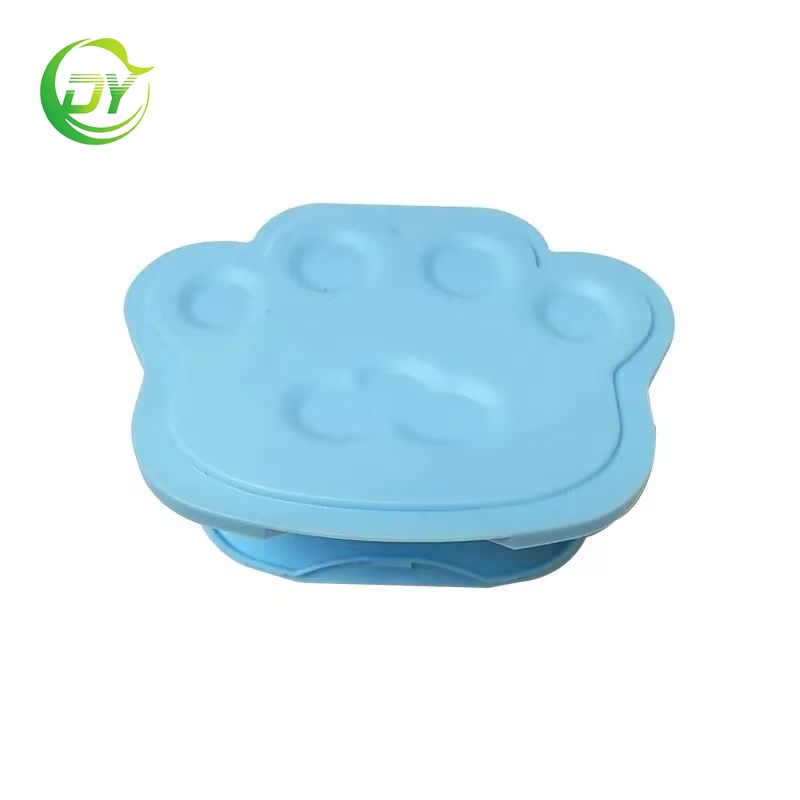
Plastic Wet Wipes Lid Wholesale buyers need the correct wet wipes lid opening size to prevent slow dispensing, torn wipes, and moisture loss. A suitable dispensing opening lets users pull one wipe at a time without damaging the next wipe. The opening must also work with the folded wipe dimensions, package film, and stack height. A lid that is too small can create high pulling force and cause wipe tearing. A lid that is too large can reduce moisture retention and allow the pack to dry faster. This guide explains how to select the opening size for different wipes and how Dongyang manufacturers can test the complete package before mass production.
The correct wet wipes lid opening size is usually 2 to 6 mm wider and 2 to 6 mm longer than the folded wipe cross-section. For common baby wipes folded to about 70 mm by 100 mm, a dispensing opening of about 65 mm by 85 mm to 75 mm by 95 mm can work, depending on the fabric, folding method, and stack pressure. The final size should be confirmed through pull-force, one-at-a-time dispensing, resealing, moisture-loss, and leak-resistance tests. A good opening is large enough for easy access but small enough to protect the remaining wipes.
Wipe manufacturers often state the unfolded size, such as 150 mm by 200 mm. The lid supplier must use the folded size instead. A wipe may be folded in half, into quarters, or into a compact interfolded stack. Each method produces a different cross-section at the dispensing area.
Measure at least 30 folded wipes from the production line. Record the width, length, thickness, and variation. Use the largest normal measurement rather than the average alone. This helps prevent tight dispensing when the pack is full.
| Wipe type | Typical unfolded size | Common folded size | Suggested opening range |
|---|---|---|---|
| Travel facial wipes | 150 mm by 180 mm | 45 mm by 75 mm | 42 mm by 68 mm to 50 mm by 80 mm |
| Baby wipes | 150 mm by 200 mm | 70 mm by 100 mm | 65 mm by 85 mm to 75 mm by 95 mm |
| Makeup remover wipes | 180 mm by 200 mm | 75 mm by 100 mm | 70 mm by 90 mm to 80 mm by 100 mm |
| Household cleaning wipes | 200 mm by 250 mm | 90 mm by 120 mm | 85 mm by 110 mm to 95 mm by 125 mm |
| Thick medical wipes | 200 mm by 200 mm | 85 mm by 105 mm | 80 mm by 95 mm to 90 mm by 110 mm |
These ranges are starting points. A thick spunlace wipe may need a larger opening than a thin airlaid wipe with the same folded length and width.
For many packs, start with 2 to 6 mm of clearance on each side of the folded wipe. Increase the clearance when the wipe has high lotion content, high thickness, or a rough surface. Reduce the clearance when the product needs strong moisture protection and the wipe can be pulled smoothly.
A round opening usually needs a larger diameter than a rectangular opening. For example, a 70 mm by 90 mm rectangular opening may offer better coverage than a 90 mm round hole for a wide folded wipe. Rounded corners help reduce fabric snagging and improve the dispensing hole edge.
Round openings are common on small packs. They are easy to mold and have no sharp corners. However, a round opening may not suit a wide, flat folded wipe. Users may need more force to pull the wipe through the narrow sides.
Oval openings provide more length while keeping a smooth edge. They work well for baby wipes and facial wipes that have a wide folded profile. A typical oval opening may measure 55 mm by 80 mm or 65 mm by 95 mm.
Rounded rectangular openings provide the most usable area for large wipes. A corner radius of 3 to 8 mm can reduce snagging. This shape also supports controlled dispensing when the wipe is interfolded.
| Opening shape | Main benefit | Possible limitation | Suitable application |
|---|---|---|---|
| Round | Simple molding and smooth edge | Less useful area for wide wipes | Small travel packs |
| Oval | Longer pull path and smooth access | Needs accurate orientation | Baby and facial wipes |
| Rounded rectangle | High usable area and good wipe control | More mold detail | Household and thick wipes |
The opening size affects the force needed to remove a wipe. In many consumer packs, a target pull force of about 3 to 12 N provides a practical user experience. A result below 3 N may allow several wipes to come out together. A result above 12 N may tear the wipe or lift the package from the surface.
Test at least 10 packs at 23 degrees Celsius and 50 percent relative humidity. Test another group at low and high storage conditions when the product will face seasonal temperature changes. Record the first wipe, middle wipe, and final wipe because stack pressure changes during use.
A resealable lid must close evenly over the flexible film and the plastic base. The opening size alone does not control moisture loss. The liner, adhesive, hinge, snap fit, and package film also affect performance.
For a basic moisture-loss study, weigh sealed packs before testing. Store them at 23 degrees Celsius for 7, 14, and 28 days. Weigh each pack again. A well-designed package should meet the moisture-loss limit set in the product specification. Many buyers use a target of no more than 3 to 5 percent loss over 28 days for standard consumer wipes, but the exact limit depends on the lotion and market requirements.
The lid base must sit flat on the pack. A common plastic wet wipes lid uses polypropylene because it offers good hinge performance and chemical resistance. Material selection should consider lotion ingredients, alcohol content, fragrance oils, and preservatives.
The lid should not twist the film during application. A sealing area of about 8 to 15 mm around the opening is often used to create enough bonding space. The actual value depends on the pack size and sealing method.
| Lid design | Typical opening | Strength | Best use | Key quality check |
|---|---|---|---|---|
| Snap-on flip top lid | 45 mm to 90 mm | Fast opening and closing | Baby and household wipes | Hinge cycle and snap force |
| Adhesive lid with cover | 40 mm to 80 mm | Low tooling cost | Travel and facial wipes | Adhesion and peel strength |
| Large oval lid | 60 mm by 90 mm or larger | Easy access for thick wipes | Cleaning and medical wipes | Opening edge and leak resistance |
| Child-resistant lid system | Product-specific | Reduces access by young children | Special chemical or medical products | Applicable child-resistant standard |
A flip top lid is a strong choice for high-use packs. It protects the dispensing area after every use. For plastic wet wipes lid wholesale orders, buyers should confirm hinge type, lid weight, base thickness, snap-fit design, and compatibility with the packing machine.
An adhesive lid can reduce initial tooling cost. It works best when the pack film has a clean, flat surface. The adhesive should keep its bond after repeated opening, lotion contact, and temperature changes. It may be less suitable for very large openings or thick wipe stacks.
The following flow chart can help buyers and manufacturers move from product data to a stable mass-production design.
Wipe data collection
then
Folded size and thickness measurement
then
Opening shape and clearance calculation
then
Prototype mold or sample lid production
then
Full-pack dispensing test
then
Moisture retention and closure test
then
Pilot production approval
then
Mass production and batch inspection
Record the unfolded wipe size, basis weight, thickness, lotion loading, fold method, number of wipes, package film, and sealing temperature. Also record the expected storage life. These details are needed before the lid opening is designed.
Dongyang lid suppliers can use 3D design, CNC mold inserts, and injection molding trials to compare several opening sizes. A practical development plan may include three opening lengths and three opening widths. This creates nine combinations for testing without changing the whole package structure.
For each prototype, test at least 30 packs. Record pull force, wipe damage, multiple-wipe dispensing, lid closure, and package deformation. Keep a sample from each production condition for later comparison.
A pilot run should normally include at least 1,000 to 5,000 packs, depending on the order size and filling equipment. Check the lid after automatic application. Inspect the position, sealing area, opening alignment, and snap fit. A lid can work by hand but fail on a high-speed packing line if the base is not flat.
| Parameter | Suggested control value | Why it matters |
|---|---|---|
| Opening dimensional tolerance | Plus or minus 0.3 mm to 0.5 mm | Controls fit and dispensing force |
| Base thickness | 1.0 mm to 2.0 mm for many flip lids | Supports stiffness and sealing |
| Corner radius | 3 mm to 8 mm for rounded rectangles | Reduces wipe snagging |
| Hinge cycle target | At least 1,000 opening and closing cycles | Checks repeated-use durability |
| Snap closure force | Product-specific, often 8 N to 25 N | Balances closure security and user effort |
| Pull force | About 3 N to 12 N | Supports smooth one-wipe dispensing |
| Visual defect limit | Zero cracks, short shots, flash, or sharp edges | Protects safety and brand quality |
Injection molding machines should control melt temperature, mold temperature, injection pressure, cooling time, and cycle time. The exact settings depend on the selected resin and lid design. Operators should check the first molded pieces after every material change, mold adjustment, or shift change.
Common inspection equipment includes digital calipers, profile projectors, pull-force gauges, torque meters, electronic scales, temperature chambers, leak testers, and vision inspection systems. Digital calipers with 0.01 mm resolution can measure the opening, but the inspection plan should define the allowed tolerance.
Quality teams may use ASTM, ISO, EN, or internal customer standards for package testing. ASTM D4169 can support distribution performance studies. ASTM F88 can be used for seal strength testing when the package uses heat-sealed film. ISO 11607 is relevant when wipes are sold as sterile medical packaging. Child-resistant products may require testing under the applicable regional regulation.
The correct standard depends on the product claim and sales market. A general household wipe does not need the same validation plan as a sterile medical wipe.
The opening may be too small. The edge may also have flash, a sharp corner, or an uneven radius. Increase the opening by 2 to 4 mm, polish the mold surface, and inspect the edge under magnification.
The opening may be too large, or the interfold pattern may be unstable. Reduce the opening width, adjust the folding process, or add a controlled dispensing feature. Test both the first wipe and the last wipe because stack pressure changes during use.
Check the lid seal, adhesive, flexible film, and closure pressure. A large opening can increase the exposed area, but poor bonding around a small opening can create the same result. Conduct a 28-day moisture-loss test and inspect the pack for air leakage.
Check hinge fatigue, snap-fit wear, resin flexibility, and lotion contamination. A lid should remain aligned after at least 1,000 cycle tests when this is part of the product specification.
A useful wholesale quotation should include more than the unit price. Ask for the following information:
For a production lot, inspect the lid dimensions, color, surface, hinge, snap fit, and opening edge. A common quality plan may use visual inspection for every carton and dimensional checks on samples from each production batch. Buyers can define an acceptable quality limit, such as 1.0 percent for major defects and 2.5 percent for minor appearance defects, based on their own risk level and customer requirements.
Critical defects should include cracked hinges, sharp edges, incomplete molding, blocked openings, poor adhesion, and lids that cannot close. These defects should receive zero acceptance in the final inspection.
The right wet wipes lid opening size depends on the folded wipe, fabric thickness, fold method, package film, and user pull force. Most designs need 2 to 6 mm of clearance around the folded wipe, but testing must confirm the final size. Round, oval, and rounded rectangular openings each suit different products. For plastic wet wipes lid wholesale projects, buyers should request dimensional data, material details, mold controls, pilot samples, and documented testing. A measured design helps protect moisture, prevent tearing, support one-at-a-time dispensing, and reduce production problems.